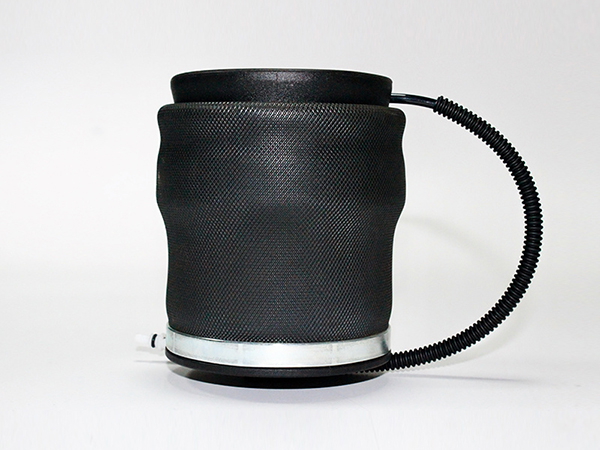
An air spring is a rubber bellows reinforced with cord fabric and filled with compressed air. It utilizes the compressibility of gas to act as a spring for vibration damping. Types include bellows (gourd-shaped), sleeve, and diaphragm types. Air springs used in automobiles can be broadly classified into free-membrane, sleeve, and bellows types. Their rubber bellows structure is similar to that of a tubeless tire, consisting of an inner rubber layer (airtight layer), an outer rubber layer, a cord fabric reinforcement layer, and a steel wire ring. The load is mainly borne by the cord fabric, the material of which determines the air spring's pressure resistance and durability. High-strength polyester or nylon cord fabric is generally used, typically in 2 or 4 layers, arranged crisscrossed and at an angle to the longitudinal direction of the bellows. Compared to metal springs, they offer advantages such as light weight, good comfort, fatigue resistance, and long service life. They also provide damping and noise reduction. They are widely used in automobiles, trains, and various types of machinery such as punching presses.
Product Advantages and Features
1. Adjustable spring height, load capacity, and spring stiffness
2. Relatively low natural frequency
3. Good high-frequency vibration isolation and noise reduction
4. Utilizes the damping effect of air
5. Long service life
Performance Parameters
Commonly used automotive air springs are divided into membrane, sleeve, and bellows types. The main components include a top cover, pressure plate, piston, stop, and retaining ring. The top cover, pressure plate, piston, and bellows form a closed system. Compressed gas (pressure 0.2~0.7MPa) is filled into the sealed air spring, utilizing the gas's compressibility to achieve its spring function. A height adjustment valve controls the internal pressure of the bellows, making the stiffness of the air spring adjustable. When the load on the spring increases, the pressure increases, and the stiffness of the spring increases. Conversely, when the load decreases, the internal pressure of the spring decreases, and the stiffness decreases.
| Serial Number | Property Name | Performance Requirements |
| 1 | Hardness, Shore A | 60±5 |
| 2 | Tensile Strength, | ≥15 MPa |
| 3 | Elongation at Break, | ≥400 % |
| 4 | After 7 days aging at 70℃ | Hardness change ≤±8 A, Tensile strength change ≤-20%, Elongation at break change ≤-20% |
| 5 | Ozone Resistance (120h, 100pphm, 40℃, 20% elongation) | No cracking |
| 6 | Flex Cracking, Thousands of times | ≥100 |
| 7 | Low Temperature Brittleness | ≤-40℃ |
| 8 | Airtightness Requirement | 24h, Internal pressure drop ≤0.02Mpa |
| 9 | Burst Pressure | ≥3.2Mpa |
| 10 | Fatigue Test | ≥6.5 million times (in good condition) |
| 11 | Neutral Salt Spray Test | ≥200h |




 location: Home > Products > Air Spring
 pre:
pre: Back to list